

Climate disinformation can push carbon taxes off a cliff model shows
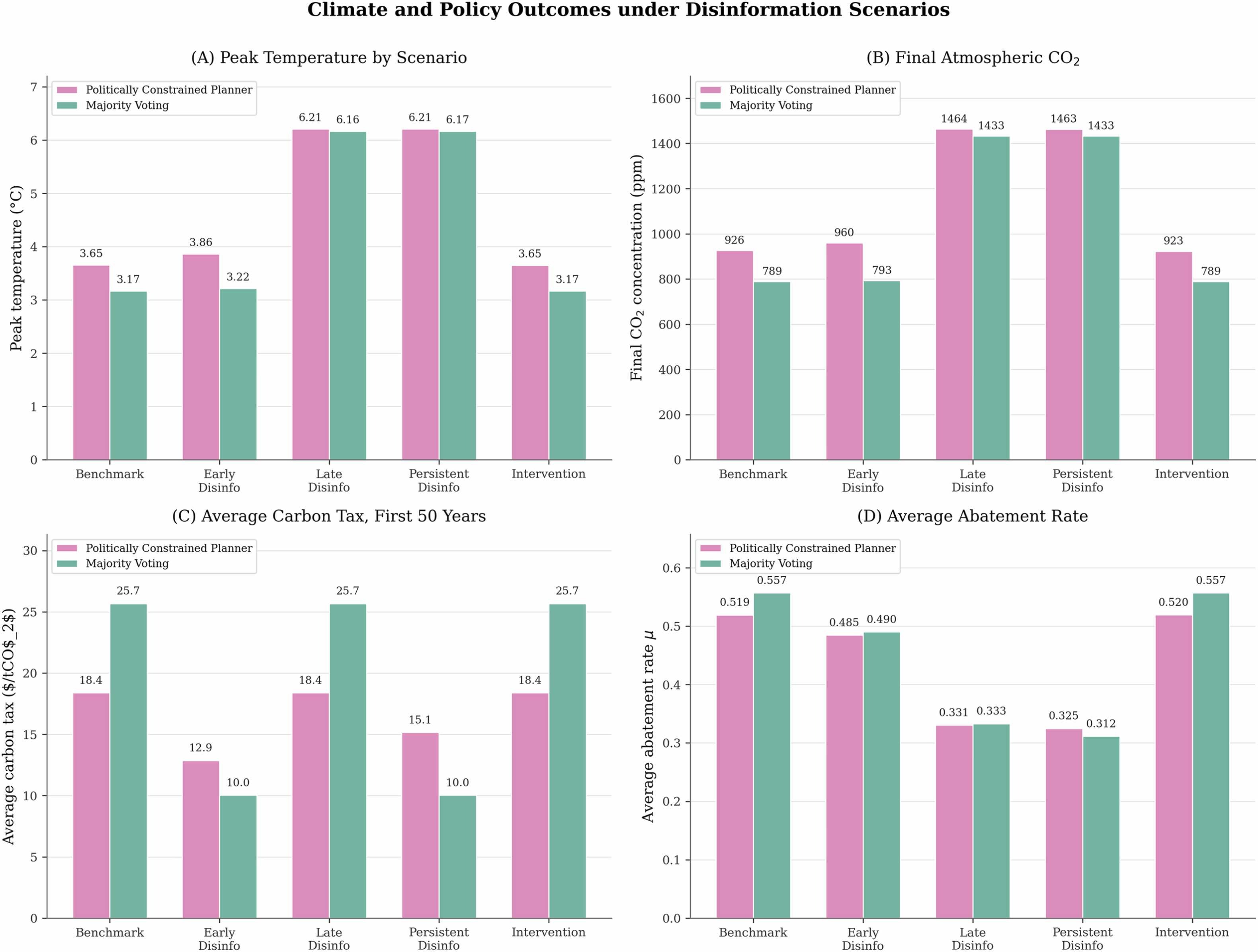
Climate and policy outcomes under disinformation scenarios
GA, UNITED STATES, October 12, 2026 /EINPresswire.com/ -- Climate policy models usually assume people hold accurate beliefs about climate damages. A new study builds disinformation into a climate–economy model and finds that informed democratic majorities can deliver stronger carbon taxes than a politically constrained planner, but this advantage collapses abruptly once disinformation tips the majority. Late and persistent disinformation yields the most severe warming, while counter-disinformation efforts can largely restore effective policy.
Carbon pricing is widely regarded as a cornerstone of climate policy, yet real-world carbon prices remain far below the levels recommended by benchmark climate models. One reason may lie not in the physics or economics of climate change, but in what people believe about it. Most climate-economy models assume that citizens hold correct beliefs about climate damages. In practice, climate disinformation can distort those beliefs and weaken support for mitigation.
In a study published in the KeAi journal Risk Sciences, researchers from University College Dublin and the ILaVita Foundation developed a dynamic climate-economy model in which the population is divided into two groups: "informed" agents, who understand the true extent of climate damage, and "misinformed" agents, who systematically understate it. The share of informed agents shifts over time through learning, disinformation shocks, and feedback from visible climate harm.
The team compared two ways of setting a carbon tax. In the first, a politically constrained planner understands the true damages but faces implementation costs whenever policy exceeds what public opinion will support. In the second, policy is decided by majority voting and adjusts gradually, reflecting how slowly real tax systems change.
"Contrary to the common view that insulated planners are always better suited for long-horizon climate policy, majority voting can initially generate stronger carbon taxation than a politically constrained planner," explains corresponding author Katsiaryna Bahamazava of University College Dublin. “As long as informed voters remain the majority, the median voter backs the ambitious policy, producing stronger early mitigation and lower peak warming.”
That "democratic advantage", however, proved fragile. Once disinformation erodes the informed majority, the political target for carbon taxation shifts sharply, producing what the authors describe as a cliff-edge dynamic in which implemented policy declines rapidly. The planner, by contrast, weakens more smoothly as public support fades.
Notably, timing matters too. Disinformation arriving late or persisting over time was especially damaging because it undermines support after the transition to stronger climate policy has begun, generating "hothouse" warming trajectories under both regimes. Encouragingly, a sufficiently strong counter-disinformation intervention almost completely offset an early disinformation shock, returning outcomes close to the no-disinformation benchmark.
"Protecting the information environment is not merely a matter of public discourse or democratic quality; it is a macroeconomic component of effective climate policy," says co-author Stanley Reznikof the ILaVita Foundation. "Information policy is not just complementary to carbon pricing; it helps sustain the political conditions under which carbon pricing remains feasible."
References
DOI
10.1016/j.risk.2026.100063
Original Source URL
https://doi.org/10.1016/j.risk.2026.100063
Lucy Wang
BioDesign Research
Legal Disclaimer:
EIN Presswire provides this news content "as is" without warranty of any kind. We do not accept any responsibility or liability for the accuracy, content, images, videos, licenses, completeness, legality, or reliability of the information contained in this article. If you have any complaints or copyright issues related to this article, kindly contact the author above.
